
Updated:
Reviewed by Natalie Nassi, Esq., Managing Partner, RockPoint Law P.C.
Buying a used car in Pennsylvania can feel overwhelming when problems start showing up soon after the sale. While the Pennsylvania Lemon Law mainly covers new vehicles, used car buyers may still have important legal protections under the federal Magnuson-Moss Warranty Act, the Pennsylvania Unfair Trade Practices and Consumer Protection Law, and the implied warranty of merchantability under Pennsylvania law. If your car keeps having serious issues, keeping your repair records, reviewing your warranty, and speaking with an attorney can help you understand your options and protect your rights.
At Rock Point Law, we help Pennsylvania consumers resolve disputes involving used cars with serious defects, warranty issues, and dealer misrepresentations. Our team handles claims under the Magnuson-Moss Warranty Act, Pennsylvania consumer protection laws, and implied warranty rules. If your vehicle keeps breaking down or the dealer failed to disclose important problems, we can help you understand your options. If you bought a used car in Colorado that turned out to be a lemon, get a free case evaluation to find out whether you have a valid lemon law claim.
In this blog, we will explain which Pennsylvania laws actually protect used car buyers, how to file a claim, what evidence you need, what outcomes are realistic, and when legal representation makes sense.
What Is Pennsylvania’s Used Car Lemon Law?
According to the Federal Trade Commission, consumers purchased more than 36 million used vehicles in the United States recently, making used car disputes one of the most common consumer transaction issues. Pennsylvania does not have a dedicated used car lemon law.
The PA Lemon Law (73 P.S. § 1951 et seq.) only applies to new motor vehicles purchased or leased in Pennsylvania within the first 12 months or 12,000 miles. If you bought a used car off a dealer's lot or from a private seller, the state lemon law usually does not cover your situation.
That does not mean you have no protection. Used car buyers in Pennsylvania often have rights under the federal lemon law. The Magnuson-Moss Warranty Act (15 U.S.C. §§ 2301-2312) applies to any consumer product sold with a written warranty.
A used car with a remaining manufacturer's original warranty, a dealer's express warranty, or a certified pre-owned warranty falls under the Magnuson-Moss Warranty Act. Consumers may pursue claims under the Pennsylvania Unfair Trade Practices and Consumer Protection Law (73 P.S. §§ 201-1 to 201-9.3) if they can demonstrate that the seller knowingly misrepresented the vehicle's condition.
There is also the implied warranty of merchantability under the Pennsylvania commercial code (13 Pa. C.S. § 2314). This implied warranty means a used car must be fit for ordinary driving use unless the dealer clearly disclaims it. A car sold "as is" generally has no implied warranty.
A car sold with no "as-is" disclosure may still carry the implied warranty even if no written warranty came with the sale. Other laws, such as the federal FTC Used Car Rule (16 CFR Part 455) can also support a claim where the dealer failed to display the required Buyer's Guide window sticker at the time of sale.
Some used vehicles do fall under the PA Lemon Law if they are still within the original 12-month/12,000-mile window from the first sale. Such an occurrence is rare but possible, for example, a barely-used dealer demo or a low-mileage trade-in still inside the original warranty period.
In those situations, the manufacturer must repair a substantial defect that substantially impairs the use, value, or safety of the vehicle within a reasonable number of repair attempts. If the manufacturer fails to fix the same defect after a reasonable amount of effort, the manufacturer is liable for a refund or a replacement vehicle. Cases involving life-threatening defects often require faster action because safety is at risk.
How Do You File a Lemon Law Claim in Pennsylvania?
Filing a lemon law or warranty claim in Pennsylvania can feel confusing at first, especially if you are dealing with ongoing car problems and repair costs. Breaking the process into clear steps can make it easier to understand what to do next and how to protect your rights.
1. Figure Out Which Law Applies
Start by gathering your purchase agreement, warranty paperwork, and any repair records you already have. You should also check whether the car was sold “as is” or with a warranty and review the FTC Buyer’s Guide sticker, since those details help determine what legal protections may apply to your case.
2. Keep Records of Every Repair Attempt
Make sure you save every repair invoice, work order, and service receipt related to the defect. It helps to track the dates, mileage, how long the vehicle was in the shop, and whether the same issue keeps coming back.
3. Send a Written Demand Letter
Once you have your documents together, send a written demand letter to the dealer or manufacturer explaining the problem. Include the repair history and warranty information, and clearly state the outcome you are asking for, such as a repair, replacement vehicle, or refund.
4. Give the Dealer or Manufacturer Time to Respond
After sending the letter, allow a reasonable amount of time for a response, which is often around 30 days. In some cases, you may resolve the issue during this stage without needing to file a lawsuit.
5. File a Legal Claim if the Problem Is Not Resolved
If the dealer or manufacturer refuses to help, you may need to file a legal claim in court. Pennsylvania consumer protection claims are generally filed in the Court of Common Pleas, while Magnuson-Moss Warranty Act claims may be filed in either state or federal court depending on the situation.
6. Pay Attention to Filing Deadlines
Timing matters because lemon laws and warranty claims are subject to legal deadlines. Pennsylvania consumer protection claims are generally subject to a six-year limit, while many Magnuson-Moss warranty claims follow a four-year deadline from the date the vehicle was delivered.
Pennsylvania Used Car Lemon Law: Comparing Your Legal Options and Possible Trade-Offs
Understanding which law applies to your situation can significantly affect a Pennsylvania used car lemon law case. The table below breaks down the most common legal protections, what each one covers, and the trade-offs consumers should know before moving forward with a claim.
| Legal Protection | What It Covers | Best For | Potential Trade-Offs |
|---|---|---|---|
| Pennsylvania Lemon Law | Covers certain new vehicles with substantial defects within the first 12 months or 12,000 miles. In rare cases, a low-mileage used car may still qualify if it remains inside the original coverage period. | Consumers who purchased a nearly new vehicle with ongoing serious defects. | Strict eligibility rules apply, and most used cars do not qualify. |
| Magnuson-Moss Warranty Act | Applies when a used car is sold with a written warranty, certified pre-owned warranty, or remaining manufacturer warranty. | Buyers dealing with repeated repair problems that are covered under warranty. | You must prove the defect falls within warranty coverage and that reasonable repair attempts were made. |
| Pennsylvania UTPCPL | Protects consumers from deceptive or misleading dealer practices during the sale process. | Cases involving hidden defects, false promises, or dealer misrepresentations. | These claims can require stronger evidence showing deceptive conduct by the dealer. |
| Implied Warranty of Merchantability | Requires a vehicle sold by a dealer to be reasonably fit for ordinary driving use unless properly sold “as is.” | Buyers whose vehicles became unsafe or unreliable shortly after purchase. | “As is” sales may limit or eliminate this protection. |
| FTC Used Car Rule | Requires dealers to display the Buyer’s Guide window sticker explaining warranty coverage and sale terms. | Consumers who were not properly informed about warranty or “as is” status. | This rule alone may not guarantee compensation but can strengthen other claims. |
| Hiring a Lemon Law Attorney | Helps identify the strongest legal strategy, organize evidence, and negotiate with dealers or manufacturers. | Consumers facing repeated repairs, denied warranty coverage, or complicated claims. | Legal cases can still take time, even when strong evidence exists. |
| Handling the Claim Without an Attorney | Allows consumers to communicate directly with the dealer or manufacturer and attempt a resolution independently. | Smaller disputes or situations where the dealer is cooperating early. | Consumers may face delays or pressure from experienced dealer representatives and insurers. |
What Evidence Is Needed for a Lemon Law Claim?
"Many used car disputes come down to documentation," says Steven Nassi, attorney at RockPoint Law. Repair records are the spine of any lemon law case for cars. Every visit to the dealer or repair shop should produce a written repair order. Save them all. The repair order should list the date, the mileage, the customer complaint, the technician's diagnosis, the parts replaced, and the time the vehicle was in the shop. A pattern of repeat visits for the same issue is often the strongest part of the case.
Communication logs are the second category. Save every email, text message, and voicemail exchanged with the car dealer, the service manager, and the manufacturer's customer assistance line. Send important communications in writing rather than by phone whenever possible.
A written record of the dealer's promises and the manufacturer's responses can be decisive at settlement. Keep the FTC Buyer's Guide window sticker from the time of sale, the purchase agreement, and any service contract paperwork.
Other useful documentation includes photos and video of the defect, an independent diagnostic from a non-dealer mechanic, the vehicle's CARFAX or AutoCheck history report, and a written timeline you draft yourself listing every defect and every repair. For complex mechanical issues, an expert report from a qualified automotive technician may be needed at the lawsuit stage. The more organized and complete the file, the stronger the demand letter and the better the negotiating position.
What Are the Possible Outcomes of a Lemon Law Claim?

Recovery in a Pennsylvania used car lemon case depends on which law applies and what the dealer or manufacturer did. Under the Magnuson-Moss Warranty Act, a successful claimant can recover actual damages plus reasonable attorney fees and costs (15 U.S.C. § 2310(d)(2)).
Under the Pennsylvania Unfair Trade Practices and Consumer Protection Law, a successful claimant can recover actual damages, treble damages in some cases (up to three times actual damages under 73 P.S. § 201-9.2), and reasonable attorney fees and other legal fees. Implied warranty claims under 13 Pa. C.S. § 2314 usually allows recovery based on the difference between the vehicle's value when delivered and its value as warranted, plus any incidental and consequential damages.
The practical remedies fall into three categories. A refund means the manufacturer or dealer returns the purchase price, less a reasonable use offset based on miles driven. A replacement vehicle means the consumer receives a comparable vehicle in working condition. Repair means the dealer or manufacturer fixes the defect at no cost to the consumer and may also pay for incidental costs like rental car expenses. Most cases resolve through settlement before trial, often within three to six months of the demand letter.
Outcomes vary with the facts. The strength of the repair history, the warranty coverage in place, the dealer's conduct during the sale, and whether the defect is life-threatening or safety-related all affect the result. Past results do not guarantee similar outcomes in any specific case. For examples of resolved matters, visit Rock Point Law's settlements page.
Why Is Legal Representation Important for Lemon Law Claims?
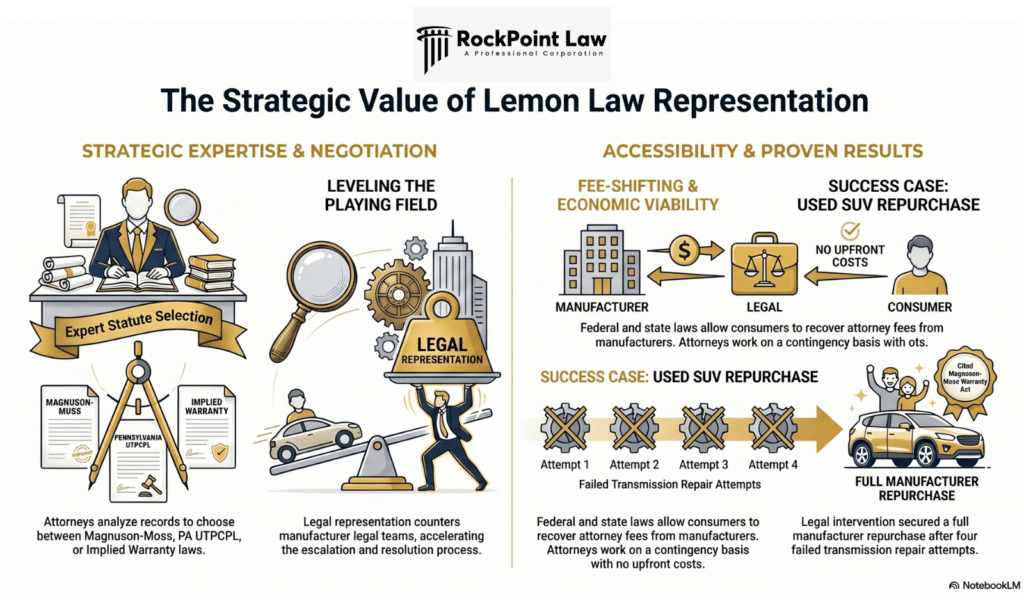
Statute selection is the first reason to consult an attorney. The Magnuson-Moss Warranty Act, the Pennsylvania Unfair Trade Practices and Consumer Protection Law, and implied warranty law each authorize different remedies and run on different timelines.
An attorney who handles lemon law claims regularly can read the purchase paperwork, the warranty documents, and the repair records and identify which law provides the best path. The choice changes what evidence matters and what the demand letter should say.
Negotiation is the second reason. Manufacturers and franchised dealers have experienced legal counsel and standard playbooks for lemon law correspondence. A consumer writing on their letterhead is at a structural disadvantage. An attorney who knows how the manufacturer's customer assistance line escalates files, how dealer counsel evaluates claims, and what a credible demand looks like can move the case faster.
Fee shifting under federal lemon law and Pennsylvania law is the third reason representation is economically viable for consumers. The Magnuson-Moss Warranty Act allows recovery of reasonable attorney fees by a prevailing consumer (15 U.S.C. § 2310(d)(2)).
The Pennsylvania UTPCPL also allows attorney fees for a prevailing consumer (73 P.S. § 201-9.2). These fee-shifting provisions are why most lemon law attorneys for consumers handle cases on a contingency basis and why a lemon law consultation typically costs nothing up front.
In a past case, a RockPoint Law client purchased a two-year-old used SUV from a franchised dealer with the remaining factory powertrain warranty still in place. The transmission began slipping within two months. The dealer attempted repairs four times over six months for the same defect without resolving the problem. Our lemon law attorneys reviewed the repair orders, confirmed the powertrain warranty applied, and sent a written demand to the manufacturer citing the Magnuson-Moss Warranty Act and the implied warranty under 13 Pa. C.S. § 2314. The manufacturer agreed to repurchase the vehicle at the purchase price, less a use offset.
Ready to Navigate Your Lemon Law Journey With Confidence?
Pennsylvania consumers who buy a used car expect it to be safe and reliable. When a vehicle develops serious defects that affect its use, value, or safety, both state and federal laws may offer important legal protections. Acting quickly can help preserve your rights, since filing deadlines may begin running from the date of purchase or the first repair attempt, depending on the type of claim.
Have you purchased a used car in Pennsylvania that keeps having the same problems? At Rock Point Law, we help consumers pursue claims involving defective vehicles, warranty disputes, and unfair dealer practices. Our Philadelphia office works with used car buyers across the state. Our team of lemon law attorneys in Pennsylvania understands how to build strong cases using repair records, warranty documents, and Pennsylvania consumer protection laws, including the Magnuson-Moss Warranty Act. Contact us today to discuss your situation.
Frequently Asked Questions
If you have questions about the Pennsylvania Used Car Lemon Law, understanding your rights can feel confusing. These frequently asked questions explain common concerns about eligibility, protections, and available legal options.
How Does the Pennsylvania Used Car Lemon Law Protect Consumers?
The Pennsylvania Lemon Law only applies to a new car covered under the original manufacturer's warranty. Used car buyers may still have protection under state and federal laws that provide protection when a defective product is not properly repaired.
What Are the Eligibility Criteria to File a Claim Under the Pennsylvania Used Car Lemon Law?
Eligibility depends on the law that applies to your case. Factors may include an active warranty, personal use of the vehicle, and whether the car was sold “as is.”
How Can I Prove That My Car Is a Lemon Under Pennsylvania Law?
You generally need evidence of a serious defect and repeated repair attempts for the same issue. Repair records, communication history, and purchase documents can help support your claim.
Are Private Sales Covered Under the Pennsylvania Used Car Lemon Law?
Generally, no. Most protections apply only to vehicles bought from dealers or manufacturers rather than private sellers, even if a manufacturer becomes liable for certain warranty obligations.
What Remedies Are Available to Consumers Under the Pennsylvania Used Car Lemon Law?
Available remedies depend on the type of claim filed. Common outcomes include a refund, replacement vehicle, repair order, or recovery of legal costs.
Disclaimer: The information on this page is general legal information about Pennsylvania consumer protection and lemon law, not legal advice for any specific situation. Reading this page does not create an attorney-client relationship. Pennsylvania law changes and the analysis that applies to a specific case depends on facts not covered here. For advice on your situation, consult a Pennsylvania-licensed attorney directly. Past results do not guarantee similar outcomes in any specific case.